
Client Results
Real Cases.Real Outcomes.
Numbers tell the story. These case studies show how we approach complex tax and accounting challenges — and what it means for the clients we serve.
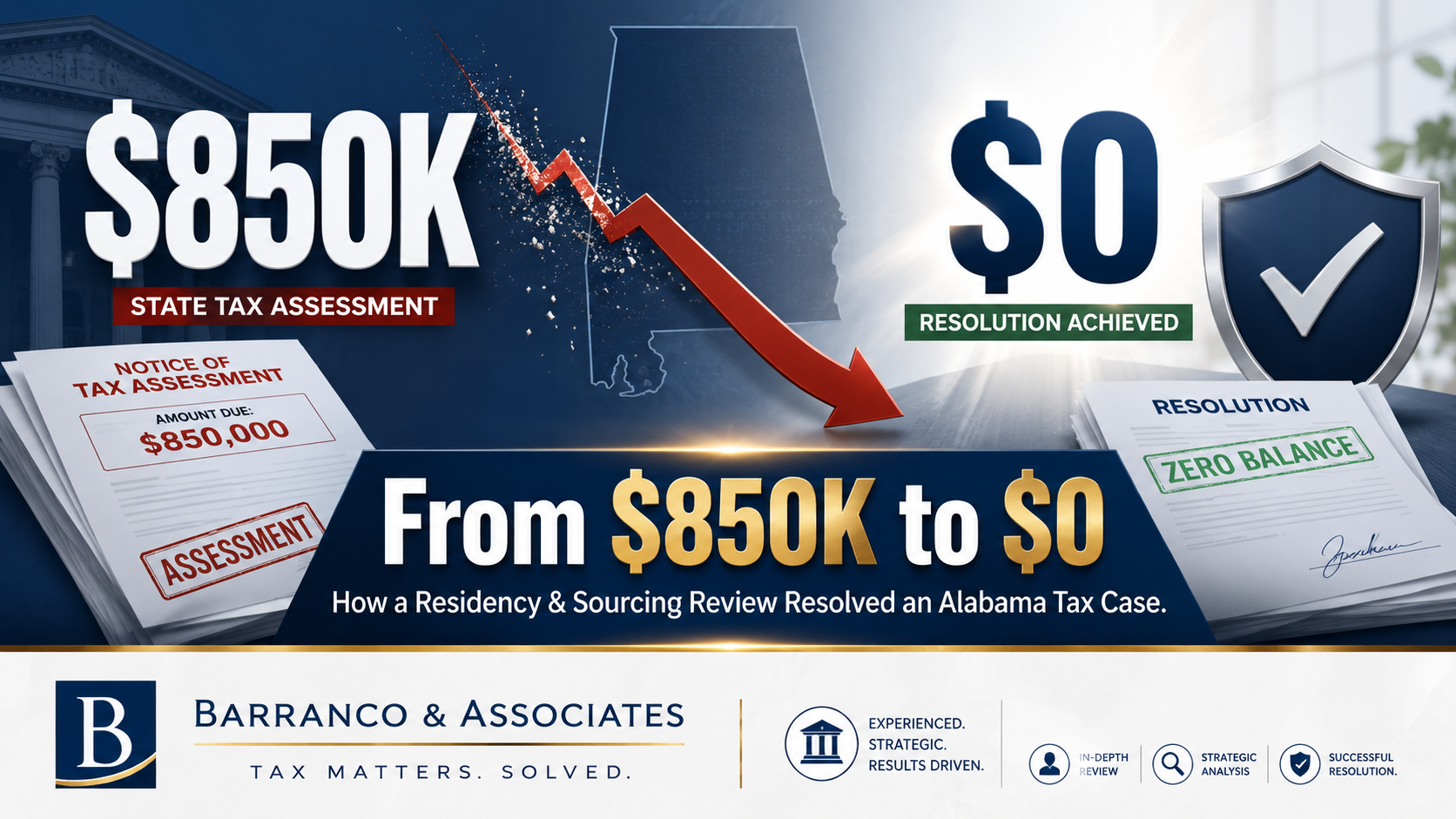
From $850,000 to $0: How a Residency & Sourcing Review Resolved an Alabama Tax Case
A nonresident business owner received an $850,000 Alabama state tax assessment. Through a careful review of residency status and income sourcing rules, Barranco & Associates reduced the liability to zero.
Background
Our client was a high-income professional who had relocated out of Alabama but continued to earn income from business activities with Alabama connections. The Alabama Department of Revenue issued a Notice of Tax Assessment for $850,000, asserting that a significant portion of the client's income was Alabama-sourced and subject to state income tax.
The client came to us after receiving the assessment notice, uncertain of their rights and overwhelmed by the size of the claim. They needed someone who understood both the technical tax law and how to navigate the state's administrative process.
The Challenge
Alabama's nonresident income tax rules are nuanced. The state taxes nonresidents on income derived from Alabama sources — but what qualifies as "Alabama-sourced" depends heavily on the nature of the income, where services are performed, and where intangible assets are used or managed.
- The assessment assumed all business income was Alabama-sourced based on the client's prior residency and business ties
- The client had not filed Alabama nonresident returns after relocating, creating a compliance gap the state used to support its position
- The $850,000 figure included penalties and interest that had accrued over multiple tax years
- The state's initial position was aggressive — and without a well-documented rebuttal, the assessment would stand
Our Approach
We conducted a comprehensive review of the client's residency timeline, income sources, and the applicable Alabama sourcing rules under the Alabama Department of Revenue regulations and relevant case law.
- Documented the client's change of domicile with supporting evidence — driver's license, voter registration, property records, and time-tracking logs
- Analyzed each income stream individually to determine whether it met the legal definition of Alabama-sourced income under nonresident rules
- Identified that the majority of the income was derived from intangible assets and services performed outside Alabama — not subject to Alabama tax
- Prepared and filed corrected nonresident returns for the applicable years, establishing a clear and defensible filing position
- Submitted a formal written protest to the Alabama Department of Revenue with a detailed legal and factual analysis
The Result
The Alabama Department of Revenue accepted our position. The $850,000 assessment — including all penalties and interest — was reduced to zero. The client had no Alabama income tax liability for the years in question.
$850K
Assessment Issued
$0
Final Liability
Key Takeaways
- State tax assessments — even large ones — are not final. You have the right to protest and the right to representation.
- Residency changes must be documented thoroughly. A change of address alone is rarely sufficient.
- Income sourcing rules vary by state and by income type. Assumptions made by the taxing authority are not always correct.
- Acting quickly matters. Delays allow interest and penalties to compound and can limit your procedural options.
Download the Full Case Study
Get the printable PDF version — ideal for sharing with your advisors or keeping on file.
Download PDFFacing a similar situation?
Talk to Us
Why Timing Matters: Helping a Business Owner Save Over $12,000 Through Proactive Tax Planning
A business owner planned to buy equipment before year-end to reduce taxes. After reviewing projected income for both the current and following year, we recommended adjusting the timing — resulting in an estimated tax savings of over $12,000 and a better cash-flow strategy going into the next year.
Background
Many business owners assume tax planning means one thing: buy equipment before year-end and take the deduction. That can be good advice in some situations — but not always.
A business owner came to us near year-end considering a significant equipment purchase. Like many owners, the initial thought was simple: buy the equipment now, reduce taxable income, and lower the current year's tax bill.
But after reviewing the bigger picture, we saw something important. The client had a large job scheduled for January that was expected to substantially increase income in the following tax year. If the equipment was purchased too early, the deduction would reduce income in a lower-tax year instead of being available when the client would need it most.
The Challenge
The conventional wisdom of "spend before December 31" can actually cost a business owner money when future income is not factored in. The challenge here was helping the client see beyond the current tax year.
- The client assumed buying equipment before year-end was automatically the right move
- A large job in January would significantly increase next-year income and push the client into a higher effective tax rate
- Using the deduction in the current (lower-income) year would waste its full potential value
- Cash flow timing also needed to be considered alongside the tax strategy
Our Approach
Rather than giving a quick answer, we modeled both years together. We looked at current-year income, projected next-year income, expected tax rates, cash flow, and the timing of the equipment purchase.
- Reviewed current-year income and projected next-year income side by side
- Analyzed the effective tax rate difference between the two years
- Modeled the deduction value in each year to identify where it created the greatest benefit
- Factored in cash flow needs and financing options to ensure the timing shift was practical
- Recommended adjusting the purchase strategy so the deduction would be used in the year where it produced the greater tax benefit
The Result
The result was more than just a deduction. It was better timing, better cash-flow planning, and an estimated tax savings of over $12,000. By reviewing both years together before the transaction happened, we helped the client make a more informed decision — one that created real, measurable value.
$12K+
Estimated Tax Savings
Better Timing Strategy
What This Case Shows
Year-end tax planning should not be done in isolation. A deduction is only as valuable as the year in which it is used. Sometimes the best tax move is not simply spending money before December 31 — it is understanding when that deduction creates the most value.
- Tax planning should consider timing, cash flow, future income, and long-term goals — not just the current year
- A deduction in a lower-income year is worth less than the same deduction in a higher-income year
- Small timing decisions can create meaningful tax savings when reviewed before the transaction happens
- Proactive planning means reviewing decisions before year-end, not just reporting what already happened
Facing a Year-End Tax Decision?
Don't guess on timing. Let us model both years together before you make the call.
Received a tax notice you don't understand?
Don't wait. The sooner we look at it, the more options you have.