Many business owners operate almost entirely from one checking account. Customer payments come in. Payroll, vendors, loan payments, taxes, equipment purchases, and owner distributions all come out of the same account. The owner checks the bank balance and assumes the remaining cash is available to spend.
Unfortunately, the bank balance does not tell the whole story. Some of that money may already be needed for taxes. Some may be necessary to cover a slow month, replace equipment, or manage an unexpected expense. When everything is combined in one account, it becomes difficult to distinguish cash available for normal operations, money that belongs to the government, funds needed for future obligations, and actual excess cash produced by the business.
A company may appear financially healthy until a quarterly tax payment, equipment failure, slow collection period, or unexpected expense exposes the weakness in its cash position. A practical solution is to maintain at least three bank accounts.
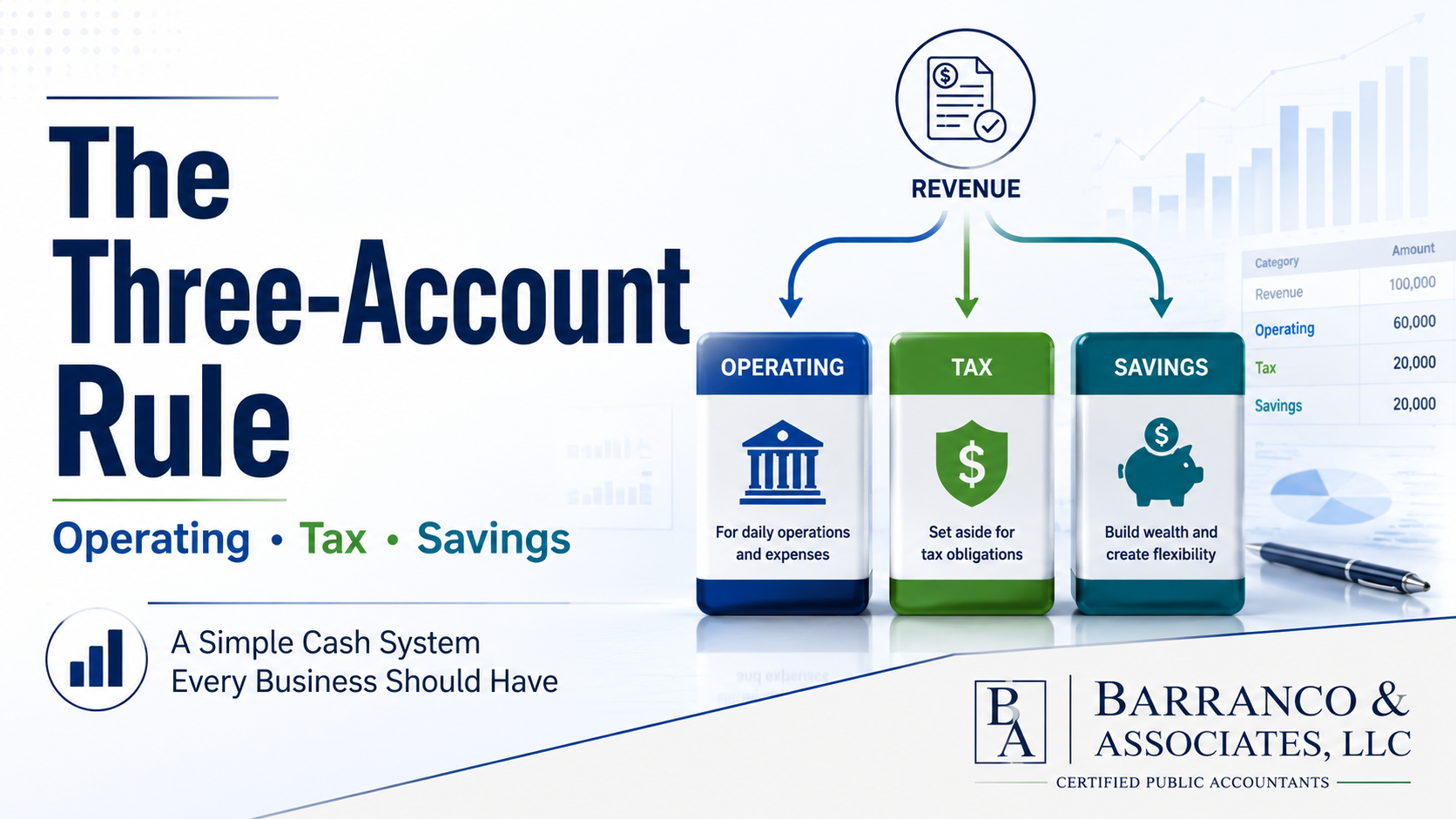
Operating Account
For daily operations and expenses. Normal business costs — payroll, vendors, rent, utilities, insurance, debt payments — are paid from here. After collections arrive, tax and reserve allocations are moved out first, leaving only what is truly available to run the business.
Tax Account
Set aside for tax obligations. Holds money reserved for income taxes and other planned tax liabilities. The correct percentage is calculated from your expected profit margin and effective tax rate — not a generic rule like "save 30%."
Savings / Reserve Account
Build wealth and create flexibility. Provides a financial cushion for seasonal slowdowns, slow-paying customers, emergency repairs, equipment replacement, and other significant business needs. Should not have routine debit-card activity or automatic drafts.
Account One: The Operating Account
The operating account is the company's primary working account. Customer payments may initially be deposited here, and normal business expenses are paid from it — payroll, vendors, rent, utilities, insurance, software, debt payments, materials, equipment repairs, and other ordinary operating costs.
However, not every dollar deposited into the operating account should remain there. After a customer payment is collected, the business should transfer predetermined amounts to its tax and reserve accounts. The operating account is then left with the portion of the payment that is actually available to run the business.
When the tax and reserve allocations are removed first, the operating account provides a much more realistic picture of whether the company's pricing, margins, overhead, and collection practices are financially sustainable. A large operating account balance can create false confidence when taxes and future obligations have not yet been separated.
Account Two: The Tax Account
The tax account holds money expected to be needed for income taxes and other planned tax obligations. For many pass-through businesses — including sole proprietorships, partnerships, and S corporations — the federal and state income-tax obligation is ultimately paid by the owners.
The correct amount to reserve should not be based on a generic rule such as "save 30% of every deposit." That may be too much for one business and dangerously low for another. The percentage should be calculated using the owner's expected federal and state income-tax rates, self-employment tax, available deductions and credits, outside income, spousal income, wage withholding, prior estimated payments, and business entity structure.
Converting the Tax Rate Into a Percentage of Sales
The owner's estimated tax rate usually applies to taxable profit, not gross revenue. Use this formula to convert it:
Expected taxable-profit margin × Estimated effective tax rate = Tax allocation % of collected sales
$1,000,000
Annual Revenue
$200,000
Expected Profit
20%
Profit Margin
6% of sales
Tax Allocation
Under this example: 20% profit margin × 30% tax rate = 6% of every collection transferred to the tax account. On a $10,000 payment, $600 moves to taxes and $9,400 remains available for operations.
Account Three: The Savings or Reserve Account
The savings account provides a financial cushion for the business. The reserve account should not be treated as another checking account — it should not have routine automatic drafts, debit-card activity, or ordinary vendor payments. The funds should be difficult enough to access that management must make a conscious decision before using them.
It may be used for:
- Seasonal revenue declines
- Slow-paying customers
- Emergency repairs
- Unexpected legal or professional costs
- Insurance deductibles
- Temporary payroll shortages
- Planned equipment replacement
- Economic disruptions
- Loss of a major customer
Sample Allocation on a $20,000 Collection
Use Collections, Not Merely Invoices
The allocation system should generally follow cash collections. An invoice does not create cash in the bank. Transferring money based on an unpaid invoice could create an operating shortage before the customer pays. When cash is collected:
- 1Record the customer payment properly.
- 2Apply the established tax percentage.
- 3Apply the established reserve percentage.
- 4Leave the remaining funds in the operating account.
When the System Exposes a Deeper Problem
If the company cannot pay its normal expenses after making reasonable tax and reserve allocations, the system may be exposing an underlying issue rather than causing one. Repeated withdrawals from the reserve to cover ordinary payroll may indicate:
- Prices are too low
- Gross margins are declining
- Overhead is too high
- Customers are paying too slowly
- Inventory is consuming too much cash
- Owner distributions are excessive
- Debt payments are too large
- The company expanded before revenue caught up with its new overhead
The Full Profit First System
Business owners who want a more comprehensive version of this approach should consider the book and cash-management system Profit First by Mike Michalowicz. The full method generally uses five foundational accounts — Income, Profit, Owner's Compensation, Tax, and Operating Expenses — and reframes the traditional formula:
Traditional formula
Sales − Expenses = Profit
Profit First formula
Sales − Profit = Expenses
The three-account system described in this article is not the complete Profit First method. It is a practical minimum for businesses that are not ready to implement the full structure. A company can begin with operating, tax, and reserve accounts and later add separate accounts for income, owner compensation, profit, payroll, capital expenditures, or other purposes.
Separate Accounts Do Not Replace Accounting
Moving cash among bank accounts does not change the company's profit, create a tax deduction, or determine taxable income. A transfer from operating to savings is not an expense. A transfer from savings back to operating is not revenue. A tax-account balance does not prove that the company has reserved the correct amount.
The business still needs accurate bookkeeping, monthly bank reconciliations, reliable financial statements, job-costing information, cash-flow projections, tax planning, and regular review of actual results. The allocation percentages should be compared with current financial information and adjusted when necessary.
A Simple System Produces Better Questions
The greatest benefit of separate accounts may not be the amount of money accumulated in them. The benefit is the information the system produces. The three accounts create three important questions:
- 1
Are we reserving enough for taxes?
- 2
Are we building financial security?
- 3
Can the business operate successfully on what remains?
Those questions are far more useful than simply asking, "How much money is in the bank?"
Start With Every Collection
A cash-management system does not have to be complicated. Begin by determining the company's expected taxable-profit margin, the owner's estimated effective tax rate, the resulting tax percentage of collected sales, the appropriate reserve allocation, the target reserve balance, and the amount that should remain available for operations. Then apply those percentages consistently whenever customer payments are collected.
At Barranco & Associates, LLC, we help business owners calculate appropriate tax reserves, evaluate cash-flow needs, establish financial targets, and understand whether their operations are producing sustainable profits. The goal is not simply to divide money among several bank accounts. The goal is to make taxes predictable, build financial stability, and reveal whether the business is truly generating enough cash to operate and grow.